In the evolving landscape of manufacturing, understanding "what is the difference between CNC turning and milling" is crucial. Both processes reshape materials, yet they do so in distinct ways. A report by the International Journal of Advanced Manufacturing Technology indicates that CNC machining markets are expected to grow by 7% annually from 2021 to 2028. This growth highlights the importance of knowing the right technique.
CNC turning involves rotating the workpiece while a stationary tool cuts the material. It excels at creating symmetrical parts. In contrast, milling uses a rotating tool to cut into a fixed piece. This method is ideal for producing complex shapes and detailed features. With 68% of manufacturers using these techniques, understanding their differences can optimize production efficiency.
Choosing the right process is not always straightforward. Factors like material type, part complexity, and batch size should guide decisions. Recognizing that each method has unique advantages allows manufacturers to adapt to varying demands. This understanding cultivates a more efficient and competitive production environment.
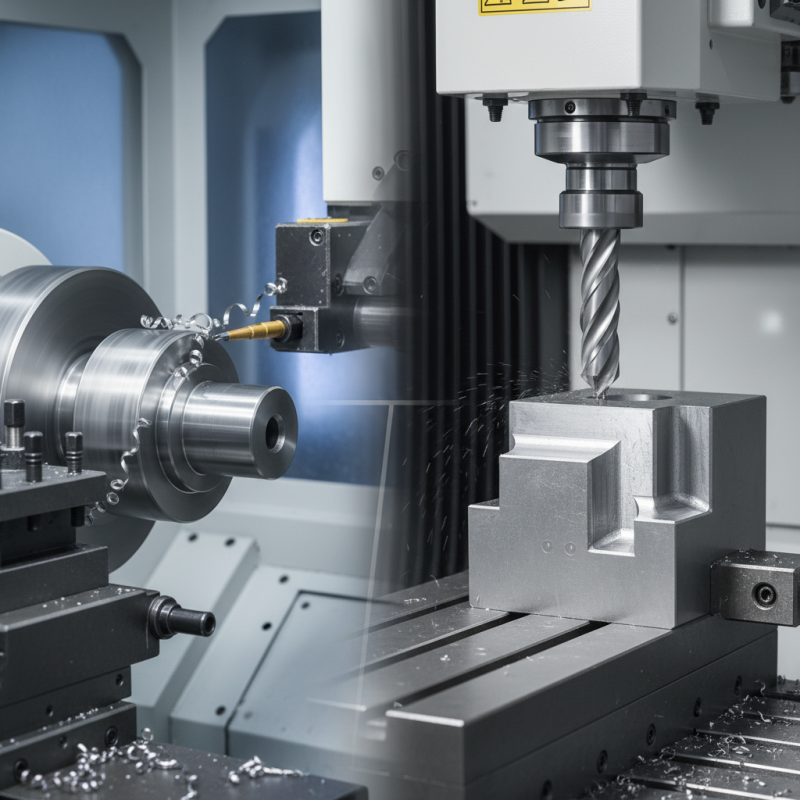
Overview of CNC Machining Processes: Turning and Milling
CNC machining processes, such as turning and milling, play vital roles in manufacturing. Turning involves rotating a workpiece while a cutting tool shapes it. This method is effective for producing cylindrical parts, like shafts and pins. According to industry reports, turning can achieve tolerances as fine as ±0.01 mm, showcasing its precision.
Milling, on the other hand, involves moving a cutting tool across a stationary workpiece. This technique excels in creating complex shapes and features on flat surfaces. Research indicates that milling can remove material at rates exceeding 10 cm³ per minute, depending on factors like tool speed and material type. However, achieving consistency in milling requires careful planning and tool selection, raising questions about efficiency.
While both processes have strengths, their applications differ significantly. Turning is preferred for symmetry and uniformity, while milling suits intricate designs. There is often a discussion on which process is superior, but it often comes down to specific project requirements. Understanding these nuances is essential for making informed decisions in CNC machining projects.
Fundamental Differences Between CNC Turning and Milling Techniques
CNC turning and milling are two primary machining processes in manufacturing. Both have unique advantages and applications, shaped by their operational mechanics. Turning uses a rotating workpiece, while milling employs a rotating cutting tool to remove material. This fundamental difference leads to various outcomes in precision, speed, and material types.
Turning is ideal for cylindrical parts. It creates smooth surfaces and intricate designs with excellent dimensional accuracy. The process minimizes waste, making it efficient for producing large quantities. On the other hand, milling provides versatility. It can create complex geometries and flat surfaces. This versatility is valuable for custom parts.
Tips: When choosing between CNC turning and milling, consider the part's shape. For rotational parts, turning is typically best. For flat or complex profiles, milling shines. Evaluate the material as well. Some materials are better suited for one process over the other.
Another consideration is production volume. Turning is efficient for high-volume production of similar parts. Milling can handle smaller, custom projects effectively. Remember that machining sometimes involves trial and error. Adjust setups and tools as needed. This can lead to unexpected improvements in quality and efficiency.
Applications and Industries Utilizing CNC Turning and Milling
CNC turning and milling are two prominent machining processes used across a variety of industries. CNC turning excels at creating cylindrical parts, making it ideal for automotive and aerospace components. It efficiently produces items like shafts and bushings. In contrast, CNC milling is better suited for complex shapes and detailed features. Industries such as electronics and medical devices benefit from this precision.
Applications extend into manufacturing custom tools and fixtures. For instance, turning is often leveraged in the production of threaded components. Conversely, milling finds its place in fabricating intricate parts like casings or brackets. Each method has its unique advantages, depending on the project's requirements.
Tips: When choosing between turning and milling, assess the part geometry first. Simple, circular designs often favor turning. Detailed, flat surfaces usually require milling. Consider material type as well; harder materials may behave differently during these processes. Always consult with experienced machinists for optimal results.
Advantages and Disadvantages of CNC Turning Vs. Milling
CNC turning and milling each offer distinct advantages and disadvantages. CNC turning excels in producing cylindrical parts efficiently. It's ideal for creating items like shafts or bushings. The process is typically faster, reducing production time for simpler geometries. However, CNC turning has limitations. It is not suited for intricate designs that require multiple orientations. Complex shapes may need additional setups or tools, increasing the cost.
On the other hand, CNC milling provides greater versatility. It can create more complex shapes, including intricate details, thanks to its multi-axis capabilities. Milling offers flexibility in material options, accommodating various types. Nonetheless, milling can be slower than turning for simpler tasks. The setup time is usually higher, which can lead to delays. Both methods require skilled operators to maximize efficiency. Understanding these trade-offs is crucial for successful manufacturing decisions.
2026 Top CNC Turning vs Milling: What Makes Them Different? - Advantages and Disadvantages of CNC Turning Vs. Milling
| Feature |
CNC Turning |
CNC Milling |
| Process Overview |
Rotates the material against the cutting tool to create cylindrical parts. |
Uses rotating cutting tools to remove material from a stationary workpiece. |
| Primary Materials |
Metals, plastics, and wood. |
Metals, plastics, composites, and more. |
| Typical Applications |
Shafts, tubes, and other cylindrical components. |
Complex shapes, molds, and prototypes. |
| Precision Level |
High precision with tolerance levels around ±0.002 inches. |
Higher precision with tolerance levels around ±0.001 inches. |
| Advantages |
Fast machining times for simple shapes; generally lower setup costs. |
Versatile for various shapes; better for intricate designs. |
| Disadvantages |
Limited to cylindrical parts; not suitable for flat surfaces. |
Longer setup times; can be more expensive for simple parts. |
| Machining Speed |
Generally faster for bulk cylindrical parts. |
Can be slower due to complex tool paths. |
| Setup Complexity |
Less complex, mainly involves tool placement. |
More complex, requires programming for various tools. |
Choosing the Right CNC Process for Your Project Needs
When choosing between CNC turning and CNC milling, it's vital to assess your project needs. CNC turning excels at producing cylindrical parts, while milling is better suited for flat or complex shapes. Both processes have their strengths, and understanding them can impact your project's success.
CNC turning is ideal for projects requiring rotational parts. This process can quickly create uniform items like shafts and bushings. However, it might fall short when dealing with intricate designs. On the other hand, CNC milling can handle detailed work, making it perfect for custom components. Still, it often requires longer setup times and may increase production costs.
Reflecting on what you need is essential. Consider the part's size, material, and complexity. Not every project is suited for one machine. Sometimes, a hybrid approach is beneficial. Each project can teach you something about the manufacturing process, leading to better decision-making in the future. Choose wisely to ensure the best outcome.
FAQS
: CNC turning involves rotating a workpiece. A cutting tool shapes it, producing cylindrical parts like shafts.
CNC turning is efficient and fast. It's ideal for creating simple geometries and reducing production time.
It struggles with intricate designs. Complex shapes may need more setups or tools, increasing costs.
CNC milling moves a cutting tool across a stationary workpiece. It excels at creating complex shapes and features.
CNC milling can remove material at rates over 10 cm³ per minute. Speed depends on tool type and material.
CNC milling offers versatility and can create intricate details. Multi-axis capabilities enhance its flexibility.
CNC milling is usually slower than turning for simple tasks. The setup time adds potential delays.
Skilled operators maximize efficiency in both turning and milling. Their expertise can significantly impact production quality.
There’s often a debate on which process is better. The answer usually depends on specific project needs.
Manufacturers must understand the strengths and weaknesses of both methods. This knowledge guides informed decision-making.
Conclusion
The article "2026 Top CNC Turning vs Milling: What Makes Them Different?" provides a comprehensive overview of the two primary CNC machining processes: turning and milling. It outlines the fundamental differences between CNC turning and milling techniques, highlighting how turning involves rotating the workpiece while milling uses a rotating tool to remove material. The article also discusses the various applications and industries that utilize CNC turning and milling, showcasing their respective advantages and disadvantages. A key focus is on the question, "what is the difference between CNC turning and milling," which is crucial for selecting the appropriate process based on project needs. Ultimately, readers are guided on how to choose the right CNC machining process tailored to their specific requirements.

 MecMill Precision